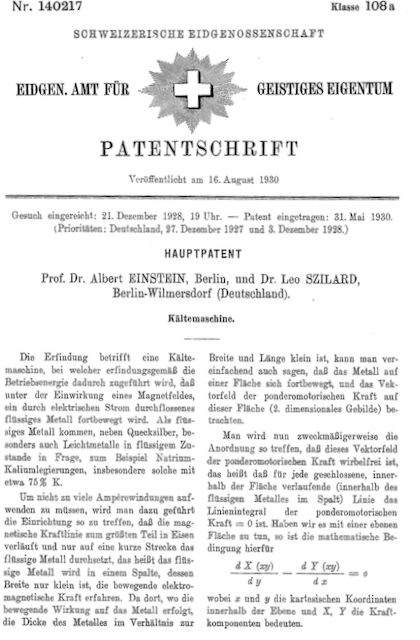
Albert Einstein is universally remembered for his groundbreaking theories of relativity and his contributions to quantum mechanics. However, his journey into the frontiers of physics began in a far more practical setting: the Swiss Patent Office in Bern, and it later led to a surprising co-invention—a refrigerator patent.
The Patent Clerk Years (1902–1909)
In 1902, after failing to secure an academic position, Einstein took a job as a ‘Technical Assistant Class III’ (patent examiner) at the Federal Office for Intellectual Property in Bern. During his time at the patent office, Einstein evaluated a constant stream of patent applications for electromagnetic and electro-mechanical devices, among others how to synchronise clocks in railway networks.
Far from being a distraction from his intellectual pursuits, this work forced him to analyze physical concepts from first principles and visualize practical mechanisms. It was during these years, in 1905 (his ‘Annus Mirabilis’ or ‘Miracle Year’), that he published his papers on the photoelectric effect, Brownian motion, special relativity, and mass-energy equivalence ()—all while working full-time as a patent clerk.
He summarised his experience there in the following words: “The source of all technical achievements is the divine curiosity and the playfulness of the tinkering and brooding researcher, as well as the constructive fantasy of the technical inventor.”
The Einstein-Szilárd Refrigerator (1926-1930)
Long after he became a world-renowned theoretical physicist, Einstein returned to the world of practical inventions. In 1926, Einstein read a tragic newspaper report about a Berlin family who was killed in their sleep when the coolant seal broke in their home refrigerator, releasing toxic sulphur dioxide into the apartment.
Motivated to create a safer alternative, Einstein teamed up with his former student, the brilliant Hungarian physicist Leo Szilárd. Together, they designed an absorption refrigerator that had no moving parts, eliminating the need for mechanical seals that could leak.
A first patent family contained the idea to use a liquid metal as a coolant pumped by magnetic induction as seen in the scan above. It seems a little odd by mentioning toxic mercury as one of the embodiments, but the inventors foresaw it to be hermetically enclosed and therefore have a much lower leaking risk. Well it was an initial thought and as often happens after some more experience a new patent family was initiated and the corresponding US patent sold to Electrolux, the Swedish appliance manufacturer that was formed in 1919.
This later design utilized a combination of butane, ammonia, and water, relying on pressure changes and heat sources (such as a simple gas burner) to drive the refrigeration cycle. The patent for the ‘Einstein-Szilárd Refrigerator’ (U.S. Patent 1,781,541) was officially granted on November 11, 1930. It never reached widespread manufacturing due to the introduction of non-toxic freon gases which made traditional compressor refrigerators much safer and cheaper to build.
However 60 years later those very freon gases opened an ozone hole in the atmosphere threatening to expose polar regions to excessive ionising radiation from the sun. Nowadays we use isobutane and propane as coolant in our fridges, so actually close to what was envisioned in the Electrolux patent. This reflects the current trade-off regarding integrity of the ozone layer combined with acceptable contribution to greenhouse gas emissions from remaining leakage to the environment.
Aftermath
Preserving food in a safe way was not to remain the most significant outcome of Einstein and Szilárd’s endeavours. In 1939, they collaborated on a letter to Roosevelt warning about the implications of a nuclear bomb in the hand of Nazi Germany. But there are plenty of posts on that story already.
